
On the road with Leonie
Our Executive Director reports from the north, south and west
Talking to the team at Unicorn
Unicorn Grocery in South Manchester, one of our members, has been running for nearly three decades. It continues to stand out as one of the most progressive—and successful—wholefood shops in the UK. No surprise then that they are ahead of the game on wanting to understand how the change in regulations for new GMOs will affect their supply chains and customers, and what they can do about it.
At their co-op training session in October, I presented the team with all they needed to know about new GMOs (and possibly a bit more). We discussed the question that I often get asked: Are there intrinsic problems with GMOs or are the only issues those that relate to the political and economic context in which they arise? From GM Freeze’s perspective, the question is irrelevant: We are working in the current context, and GMOs come with patents that lead to increasing concentration of power in the food system.
| Furthermore, the types of new GMOs being developed seem to be more about creating Leonie at the Gaia Foundation’s Seed Gathering profits than benefits to consumers or the environment. I could give an opinion beyond this but it would be just that—a personal opinion. And for food retailers, the key issue is freedom of choice for their customers, so that all opinions and preferences can be served. This is something that I hope to work on with Unicorn and other progressive retailers. | 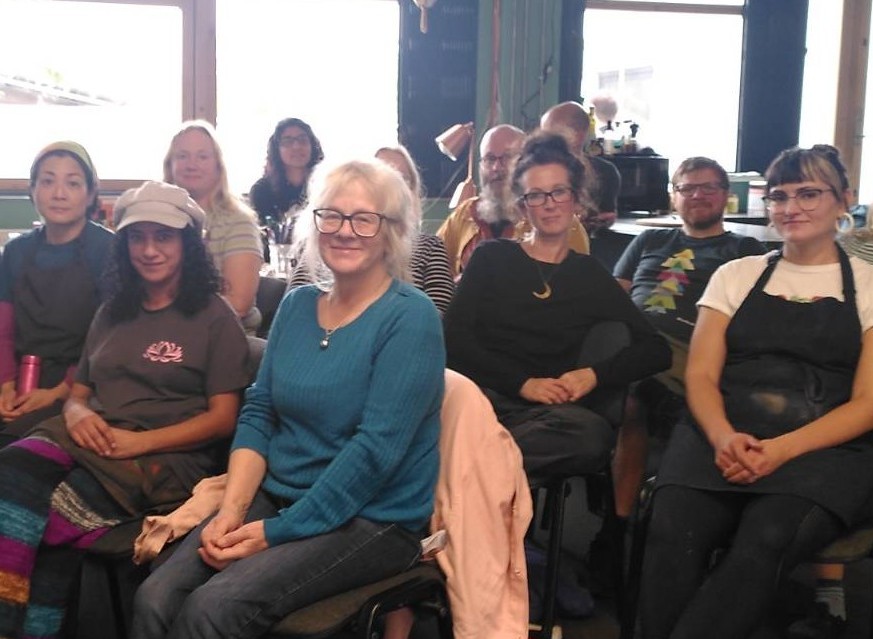 |
| Behind the scenes at Unicorn |
If you’re interested, or work for a business that would benefit from getting clued up about the forthcoming deregulation of new GMOs, please get in touch—I’d be very happy to speak to you.
Mutant Ecologies at Housmans
Much of my time is focused on fighting deregulation and advocating for sensible policies, and it’s not often I get to think about some of the more abstract and philosophical issues in relation to genetic modification. How has critical thinking around capitalist capture of the genetic commons moved on since Vandana Shiva’s seminal 1997 book, Biopiracy?
Though it’s a question that lurks in the back of my mind, I’ve not had the time to investigate. So in October, I was delighted to be invited to speak at the launch of Mutant Ecologies: how capitalism is reconfiguring the very texture of life, alongside authors Erica Borg and Amedeo Policante, and Randa Toko from the Gaia Foundation’s Seed Sovereignty Programme.
| Crammed between shelves lined with the words of countless visionary thinkers, in the King’s Cross Housmans bookshop, Erica presented us with glimpses of dystopian futures whilst Amedeo described the cellular biological processes that are increasingly being used, manipulated and expropriated for the purposes of capital accumulation. | 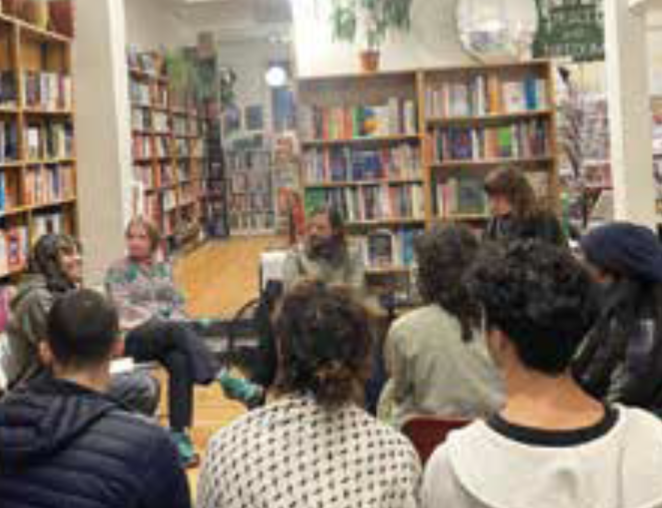 |
| Hosted by Housmans |
I fear that I may have bought the room down to earth with a bump with my rapid explanation of the forthcoming deregulation of new GMOs. At least Randa was there to pick us up with a rallying cry for Food and Seed Sovereignty.
The Seed Gathering
The Centre for Alternative Technology in Machynlleth, Wales, is no longer open as a visitor’s centre but remains a key place of learning for a range of skills needed for sustainable living. In October, it opened its doors to the Gaia Foundation’s Seed Gathering––a two-day event that brought together people passionate about seeds.
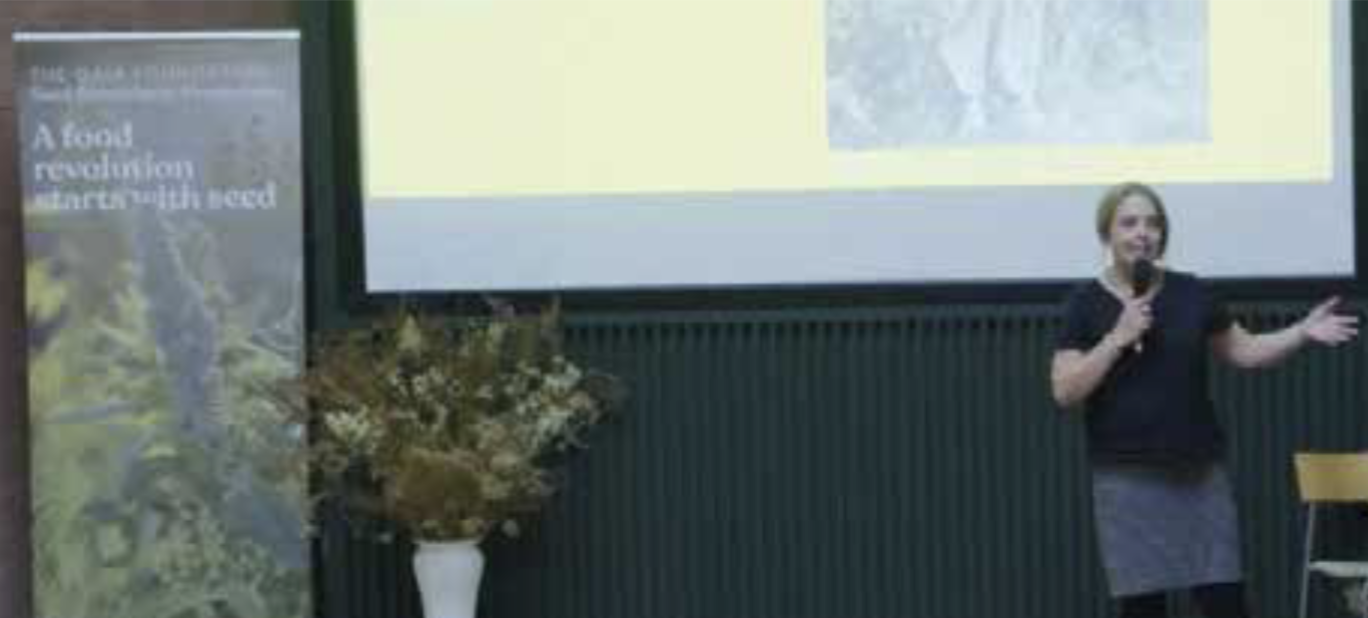
Leonie at the Gaia Foundation’s Seed Gathering
It was truly inspiring to meet so many people dedicated to cultivating abundance and resilience in our food system through the development and distribution of diverse seeds. They don’t only contribute to feeding people now, but also to the Earth’s ability in the future to sustain life.
But much as it was good to celebrate this work, I was there as an unwanted guest—to remind people of the threat posed by the deregulation of newer forms of GMOs. And not only to remind, but to connect and strategise and think about how we can protect the integrity of our seeds and freedom of choice at the opposite end of the supply chain to Unicorn. In the coming months and years, we aim to build links along the chain too.
This article first appeared in the GM Freeze newsletter, Thin Ice, issue 69.


