
Slovakia files legal challenge to GMO deregulation in Europe
GM Freeze’s Leonie Nimmo talks with Samuel Matejíčka from quid est VERITAS to find out more
When the European Parliament voted in June to deregulate new GMOs, only one country unanimously rejected the legislation: Slovakia, all of whose MEPs voted against it. This week, Slovakia again stood alone in opposing Brussels, as it filed a lawsuit challenging the new GMO laws at the Court of Justice of the European Union.
News of the pending legal challenge broke at a press conference in early September which was attended by both the Prime Minister Robert Fico and Minister of Agriculture Richard Takác.
“It was a huge relief,” Samuel Matejíčka from the Slovakian group quid est VERITAS tells me.1 “This was a big fight for us. It was keeping us awake at night.” Along with Peter Sudovský from the initiative Slovakia without GMOs, Samuel had worked for months on building the momentum behind the challenge: “We worked on communicating with every possible institution”.
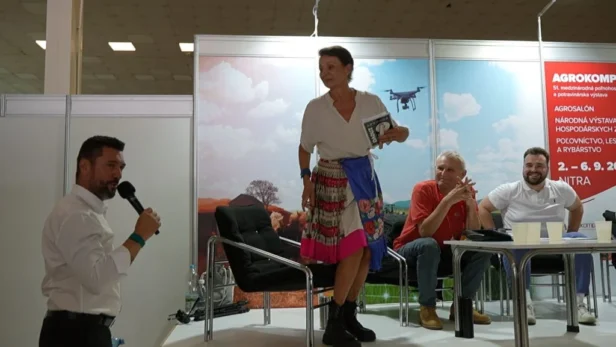
Minister of Agriculture Richard Takáč joins Samuel Matejíčka and others after the announcement of the Slovak legal challenge at the trade fair Agrokomplex, September 2, 2026. Image credit: Maxim Matejíčka.
Political influence
Samuel and Peter went to the national parliament and hosted a seminar with MPs. A meeting with the environment minister was followed by a meeting with the agricultural minister in April. They submitted to him a legal analysis, informing him that a successful European Court of Justice appeal could result in a complete cancellation of the new regulations for (the deregulation of) plants produced using New Genomic Techniques (NGTs).
Public awareness
They helped to raise awareness about the deregulation through a media campaign fought mostly on internet news channels. “The internet media—you might say alternative media—is pretty successful in Slovakia,” says Samuel. “It often has more viewers than network and mainstream media. There has been low trust in the mainstream media for a long time, which peaked during the Covid pandemic. The current opposition, who were in power at that time, were cancelling and forbidding internet media, Facebook posts etc. There were huge protests. Now there is a new government and even its members are using internet media.”
Samuel thinks that information about the new laws spread in Slovakia in ways that it didn’t in other countries. “People were listening and spreading on social media, and I noticed that people knew that something had happened. In other countries they didn’t have any information,” he said. The situation in Slovakia wasn’t influenced by traditional media: “Nobody contacted us from the mainstream media,” he said. “If you want them to cover stories, you sometimes have to pay advertising fees if they’re not interested in your topic.”
Support from allies
Another area of intense focus for Samuel and Peter was a letter that received the support of 300 Slovak and international organisations, as well as scientists and experts. “The support for the letter made a big difference,” says Samuel. “It showed that many organisations are concerned about this—it’s a serious topic.”
After sending a discreet letter to the government and receiving no response, the campaign duo went public with the letter a month after the European Parliament vote, on July 14. The result was a lot of media interest and their second meeting with Minister of Agriculture Richard Takáč, who, in media interviews, highlighted the removal of consumers’ freedom of choice as a result of the Regulations.
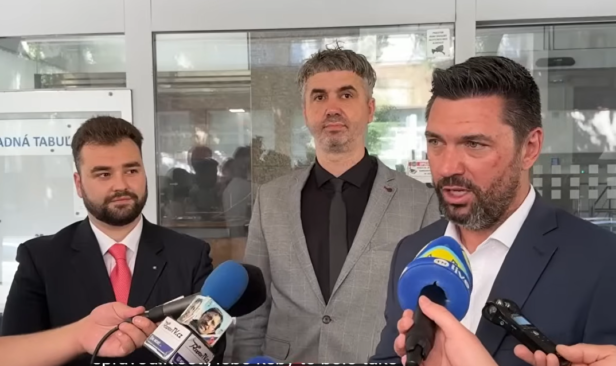
Slovak Minister of Agriculture Richard Takáč speaks to the press alongside Samuel Matejíčka and Peter Sudovský, Bratislava. July 14, 2026. Image credit: ER:TV.
But beyond the political show of strength the letter demonstrated was the boost to the campaign from the solidarity shown by other organisations across Europe: “It was really important for us to be connected to our international partners, share information, be active, not be desperate,” says Samuel. “Let’s not lose hope”.
The people versus the corporations
Samuel describes something of the corporate lobbying that was evident in Slovakia, as it was elsewhere. At the Slovak seed and plant breeders’ association, he tells me, only two of the 12 members are companies owned by Slovaks. The others are controlled from abroad and include the big four seed and pesticide companies: Bayer, Corteva, BASF and Syngenta. The association’s chair spent most of his career at Bayer (formerly Monsanto).
The day before the cabinet returned after the summer break, there was an apparent ‘information wave’ coming from the Slovak Academy of Science, and the seed and breeders’ association, according to Samuel. The association published letters sent to the Ministry of Agriculture, the President and other ministers.
In response, the European Network of Scientists for Social and Environmental Responsibility (ENSSER) prepared their own statement. Samuel said this really made a difference: “Some media organisations that covered the lobbying also covered the ENSSER response,” he said. “We showed that we have scientists on our side”. Samuel said that the connection between the scientific community and businesses plays an important role—business lobbying could consciously or unconsciously influence some scientists.
In July, a poll commissioned by quid est VERITAS found that 80% of people didn’t want to relax the rules for new GM crops, and 75% of the Slovakian population supported the legal challenge. These figures are comparable with both the UK, where around three quarters of people want labelling of all GMOs (including new ones)2, and Europe, where around 68% of people want NGTs to be labelled.
The Slovak legal challenge is a true David and Goliath story: a campaign run by just two individuals appears to have had a decisive impact on a decision that could stop the European deregulation of new GMOs in its tracks, despite the long and expensive campaign that has been waged across Europe by corporate lobbyists. But given the strong preference amongst the European public for keeping controls such as labelling for new GMOs, what is perhaps more surprising is that the Slovak government is the only one in Europe that is prepared to defend the will of the people.
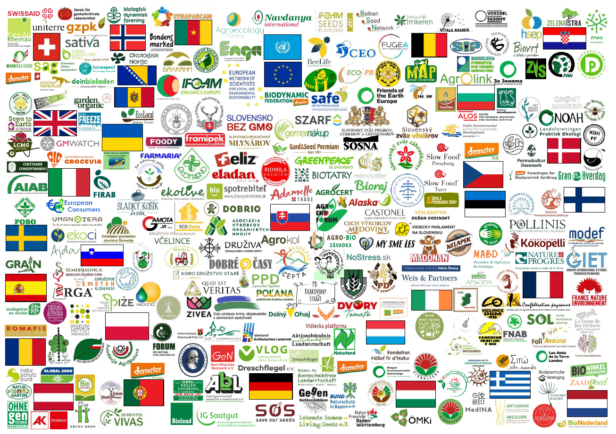
Logos of the 300+ organisations that supported the Slovak legal challenge.
Footnotes
1 Online interview, September 22, 2026.
2 According to repeated polls:
- ‘Consumer perceptions of genome edited food’, FSA, July 2021. Available from: https://webarchive.nationalarchives.gov.uk/ukgwa/20201010091010/http://www.food.gov.uk/sites/default/files/media/document/consumer-perceptions-of-genome-edited-food.pdf;
- ‘Summary of responses to a consultation on the regulation of genetic technologies’, Defra, 29th September 2021. Available from: https://assets.publishing.service.gov.uk/media/61532cc5e90e077a291f391f/genetic-technologies-regulation-summary-of-responses.pdf;
- ‘YouGov Poll: UK citizens demand robust regulation of GMOs’, Beyond GM, 18th November 2022. Available from: https://beyond-gm.org/yougov-poll-uk-citizens-demand-robust-regulation-of-gmos/


