
New GMOs: European Parliament bows to biotech
The European Parliament has voted1 to abolish safety and transparency rules for new GMOs, ignoring a mass mobilisation of citizens who demanded the right to choose. As a result, US multinationals will have greater control of the food system, say Members of the European Parliament (MEPs) who voted against the new laws.
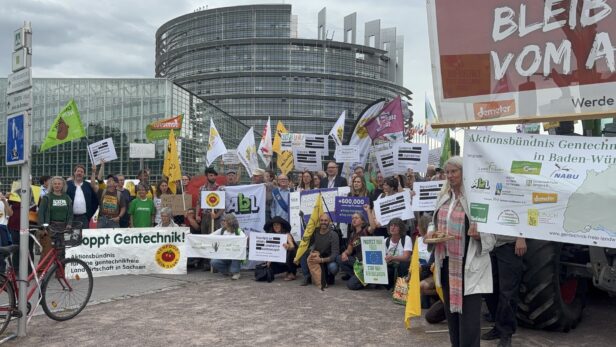
Protest against new GMO laws outside the European Parliament in Strasbourg, 16th June 2026
A long process
The June 17 vote was the climax of a process that has dragged on for three years, to some extent because biotech companies would not relax their demands around patents. Finally they won, with MEPs voting against every one of the 40-plus amendments that might have provided some checks on the new system.
The proposed changes could have ensured labelling, traceability and detection methods as well as limiting the scope of patents. They could have led to measures to avoid contamination and the spread of new GMOs in the environment. But during a tense voting session, not a single one of these safeguards was adopted.
The last time the European Parliament voted on the law—in February 2024—it voted for labelling and traceability. But these provisions have fallen by the wayside during the course of the European law-making process, involving negotiations between the European Parliament, the Council of the European Union and the European Commission. Swedish MEP Jessica Polfjärd represented the Parliament in these negotiations. She showed her disdain for any such changes with a (procedurally unnecessary) ‘thumbs down’ throughout the votes. It is little wonder that labelling and traceability did not survive.
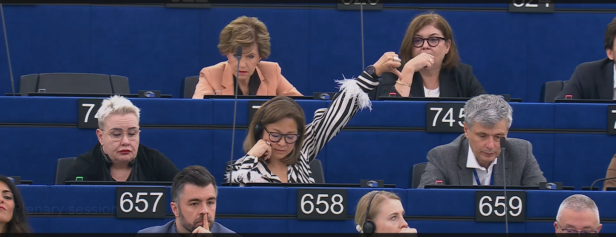
Polfjärd shows her opposition to curbs on the new GMO laws. Image credit: European Parliament Multimedia Centre
The finishing line
A series of impassioned speeches at the plenary session in Strasbourg ensured there was no possibility that MEPs could have failed to understand the implications of the vote they were taking. Martin Häusling, on behalf of the Greens/EFA Group, highlighted the lack of risk management and the dangers to the European seed sector: “All plants can [now] be patented,” he said. “There are no limits to that.”
Anja Hazekamp, on behalf of The Left Group, said that the law would undermine the very basis of the food system, and was the direct result of aggressive lobbying by the big agribiotech companies. “Vote with your hearts, vote with common sense, vote against this law,” she said.
Failure to limit the scope of patents will result in their spread throughout agriculture, including on beneficial traits such as disease resistance. Traditional breeders will be prevented from developing these crops: a blow to innovation and a massive win for the biotech industry.
 |
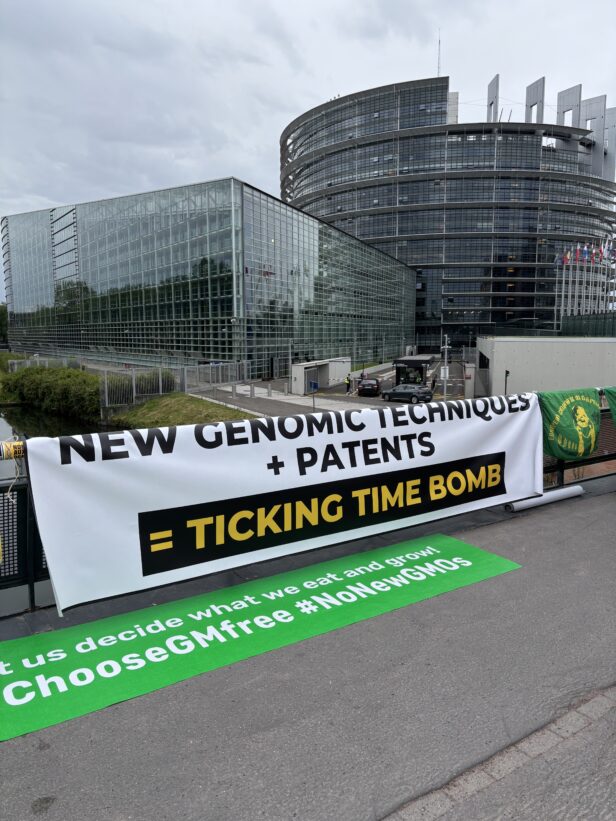 |
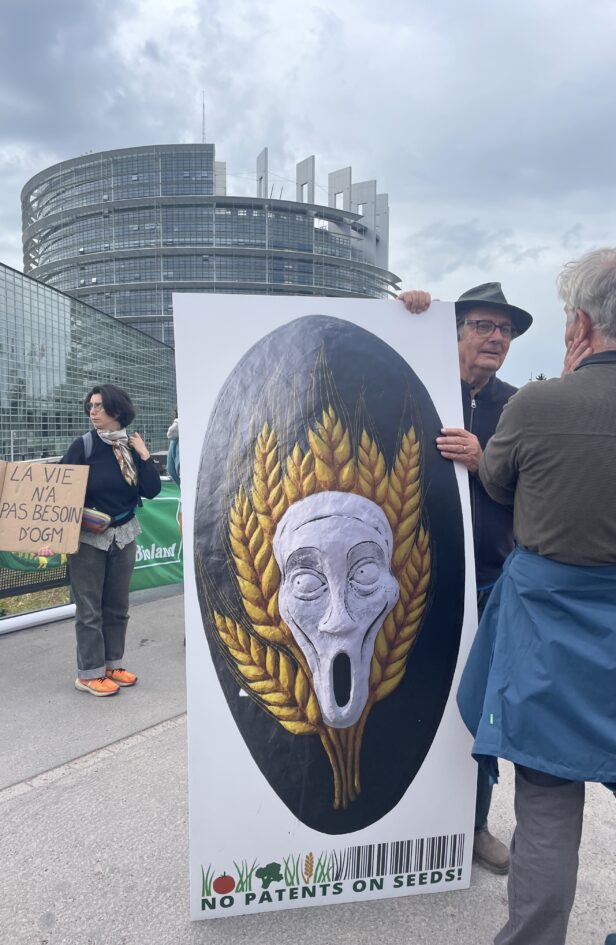
Banners in front of the European Parliament in Strasbourg highlight dangers of patents on seeds. June 16th 2026
Two days previously, during a related vote at the Environment, Public Health and Food Safety (ENVI) Committee, the room was packed with lobbyists, who are reported to have “marched out of the room afterwards…to pop the champagne”. A spokesperson for agribusiness giant Bayer told Politico: “It’s a really, really big deal for us”.
Civil society fights back
In the weeks leading up to the Parliament vote, more than 80 civil society organisations from across Europe called on the European Parliament to “reject this dangerous deal”. And it was not just environmental groups and organic farmers that opposed the new law—hundreds of mainstream retailers have called for labelling, and the largest agricultural association in Germany (DBV) has opposed the patenting of seeds. Research published by No Patents on Seeds in April 2026 found that around 80 percent of EU citizens rejected the idea of granting patents on living organisms.
Over 214,000 people emailed MEPs, and supportive MEPs reported back to campaigners that their inboxes were flooded. The Blacked-out Ingredients campaign encouraged consumers to fight for their right to know whether altered DNA is in their food: “If you stay silent now, it stays dark later.” An EKO petition calling on EU leaders to not abandon labelling, safety checks and tracebility had nearly reached 625,000 signatures by the time of the vote.
Supporters of the Blacked-out Ingredients campaign
Big win for big business
But European lobbying organisations were also united. A letter sent to MEPs and supported by a number of different industry associations, including the European Landowners’ Association, EuroSeeds and CropLife Europe, called on parliamentarians to reject any proposed amendments.
Comparing the 80+ civil society organisations opposing the law with the lobbyists who supported it, it seems a clear case of the people versus big corporations. In the end, the Parliament ignored the people. Approximately two thirds backed the new law as a whole, but votes on the individual amendments passed by a narrower margin: for a key vote on patents the difference was only around 10%. Corporate Europe Observatory described the vote as “a betrayal of farmers, consumers and science itself”.
But the fight continues
A key battle has been lost, but the fight for a just and sustainable food system in Europe will continue. According to the European Coordination Via Campesina:
…the struggle of peasant farmers and agri-food, beekeeping, environmental and consumer protection organisations does not end here. This new regulation is legally and scientifically shaky. Its incompatibility with certain provisions of the European Treaties and with the European Union’s international obligations on the regulation of GMOs (Cartagena Protocol) are weaknesses that will make it possible to challenge this unacceptable deregulation. ECVC calls on the EU Member States which have opposed this deregulation to launch proceedings to annul the regulation before the Court of Justice of the European Union. The peasant movement will remain mobilised to prevent the implementation of this dangerous regulation and will pursue all available legal options.”
“A sad day for democracy” – civil society in mourning
Here’s how some of our allies in Europe responded:
- AbL – Irresponsible decision: Legal and political resistance and self-help are coming up
- Arche Noah – New genetic engineering: EU Parliament opens the floodgates for patents
- Corporate Europe Observatory – New GMOs deregulated: a betrayal of farmers, consumers and science itself
- Crocevia – The deregulation of GMOs is law in Europe – 21 associations denounce the very serious vote against food sovereignty, the rights of farmers and consumers
- European Coordination Via Campesina – European Parliament approves the deregulation of GMO-NGT plants, but the struggle of European peasant farmers does not stop there
- European Non-GMO Industry Association (ENGA) – European Parliament approves deregulation of New GMOs abandoning transparency in the food chain
- Friends of the Earth Europe – EU lawmakers scrap basic rights for consumers, breeder, food sector
- IFOAM – IFOAM Organics Europe re-affirms commitment to produce without NGTs and warns of threats on European seed sovereignty
- Save our Seeds – A sad day for democracy and science
- VLOG – New EU rules: “Ohne Gentechnik” will require a seal in the future
Footnote
-
1For the recording, see: https://multimedia.europarl.europa.eu/en/webstreaming/plenary-session_20260617-0900-PLENARY Time code: 12:33:50 – 12:49:00


