
Slovakia considers legal challenge to European deregulation of new GMOs
Three hundred organisations and prominent people from Slovakia and across Europe have urged the Slovak Government to take legal action against the European approval of deregulation of genetically modified organisms (GMOs) made using new genomic techniques (NGT).
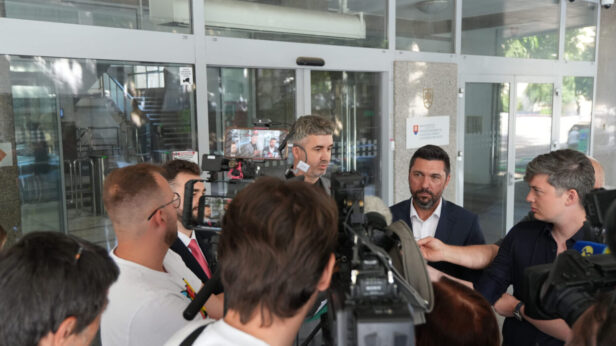
Slovakian Minister of Agriculture Richard Takáč meets with Quid est Veritas and Slovakia without GMOs, Bratislava, 14th July 2026.
The Regulation, which was adopted on 17th June 2026, will allow genetically engineered food to be sold without mandatory labelling, without risk assessment, and without the possibility of banning unsafe products. Signatories argue that this was approved despite contradictions with scientific evidence, EU law, and public opposition—and that it benefits large agrochemical companies through patents, while exposing farmers, food producers, consumers and the environment to risks.
The call was co-ordinated by Quid est Veritas and Slovakia without GMOs and is supported by GM Freeze and a number of our members. It warns that NGT-based products can lead to unwanted DNA mutations and potential plant risks, including allergenicity and possible toxicity. In particular, they criticise “category 1” new GMOs as being fully deregulated despite lacking scientific justification. They also point to technical analyses which shows serious legal conflicts with EU and international obligations, including:
- EU consumer information and choice rights (Treaty on the Functioning of the EU, Article 169): removing labelling makes it impossible for consumers to avoid risk and make informed decisions.
- The precautionary principle (Article 191): the regulation ignores the requirement to handle scientific uncertainty cautiously rather than by deregulating.
- The Cartagena Protocol on Biosafety: the approach violates this binding international agreement, which calls for strict, case-by-case regulation.
- An EU Court of Justice ruling (C-528/16): signatories cite this ruling to argue that products made with new genomic techniques must be treated as GMOs and regulated accordingly.
For these reasons, the signatories are calling on the Slovak Government to challenge the regulation before the Court of Justice of the EU, with the aim of having it annulled and keeping the current rules. Under EU law, the window is open until 26th August 2026.
Slovakia is described as a leading critic of deregulation. Support for the position is said to be broad: the reform was rejected across Slovakia’s political and institutional landscape, with signatories thanking the full political spectrum for aligning on the issue alongside public concerns. The signatories include farmers, beekeepers, conservationists, hunters, ecologists, scientists, cultural and church representatives, and former ministers, as well as major organisations from across EU countries.
On 14 July 2026, the coordinators of the call—Peter Sudovský and Samuel Matejíček—met personally with Minister of Agriculture Richard Takáč. They say it was their second meeting: the first was on 16 April 2026, when they delivered the Slovak and European public position and preliminary legal analyses supporting their claims. At the latest meeting, they discussed the risks associated with deregulation and the Minister reportedly emphasised the need to protect consumers’ right to information and freedom of choice.
Afterwards, the coordinators and the Minister briefed the media. The Minister confirmed interest in filing a complaint with the Court of Justice of the EU. This would be preceded by a final review of legal materials from the Slovak Ministry of Foreign Affairs and documents submitted by the signatories, and then by approval of the procedure at a Government meeting.
The organisers argue that by backing this challenge, Slovakia can reaffirm sovereignty and help protect citizens of the EU, nature, and fundamental democratic rights.
The legal challenge and signatories can be accessed here and remains open for signing; a poster with signatory logos is here.


