
Q: What connects the world authority on nature with genetically engineered dogs of war?
A: Colossal Biosciences
The International Union for Conservation of Nature (IUCN) announced in September a $4 million partnership with the non-profit arm of genetic engineering company Colossal Biosciences. A month later, it was announced that Colossal owns equity in Warhound, a start-up that aims to genetically engineer, clone and armour military dogs.
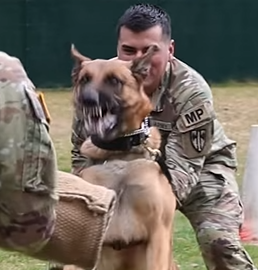 |
U.S. Army Military Police train with their military working dogs on Miesau Army Depot, Germany, January 27, 2026. Screenshot of U.S. Army video by Pfc. Kadence Connors. Source: commons.wikimedia.org |
|
Cashing in on conservation
News of the IUCN/Colossal deal broke a year after the multinational conservation organisation passed a controversial policy to allow genetic engineering in the wild. The agreement includes a global joint communications campaign, and will grant Colossal access to the steering committee of the IUCN’s Species Survival Commission.
According to the MIT Technology Review, Colossal wants to introduce patented, genetically engineered elephants—woolly mammoth lookalikes—into nature reserves in Siberia and generate carbon credits in the process.
Co-founder and CEO of Colossal Ben Lamm is quoted by Forbes as saying: “The reintroduction of animals back into their habitats creates the potential for annuities in carbon credits, nature credits and tourism taxes.” Forbes estimates Lamm to be worth to be worth $5.7 billion.
Dr Angelika Hilbeck, retired from the Swiss Federal Institute of Technology, told GM Freeze: “What habitats? ‘Their habitats’ are gone, done and dusted since 10,000 years ago—have they talked to the people of Siberia?”
Lamm describes Colossal’s work as de-extinction, but critics such as Dieter Hochuli, a professor at the Integrative Ecology Lab at the University of Sydney say this “isn’t just a misleading term, but a dangerous one that promotes false hope and perverse incentives at the expense of existing conservation efforts that are proven to work.”
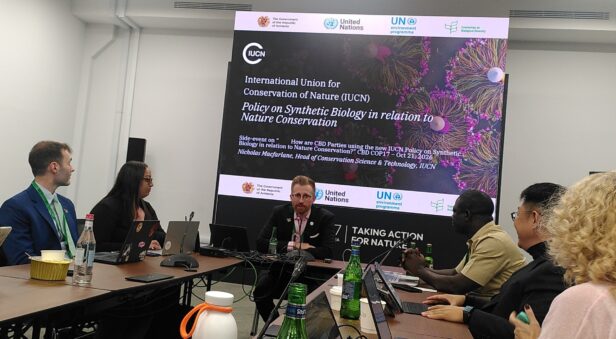
Nicholas Macfarlane of the IUCN introduces the organisation’s policy on synthetic biology at the Convention of Biological Diversity COP17 in Yerevan, Armenia, October 23 2026.
IUCN experts will evaluate how various technologies used by Colossal could be applied, including gene editing, a form of genetic engineering. Lamm’s spin on the IUCN deal steered away from financial returns but did imply an intention to deploy genetic engineering, via the IUCN, at scale: “The future of conservation depends on getting powerful technologies out of the lab and into the hands of the people working closest to species at risk… deploying them with the urgency, ambition and scale the extinction crisis demands.”
Hilbeck questioned why lab-based technologies would help address species extinction, telling GM Freeze: “It was and is ‘powerful technologies’, including genetic engineering technologies such as herbicide resistance in crops, that keep driving species extinct at breathtaking speed today… So far Colossal hasn’t been able to ‘recreate’ anything extinct—they have just generated transgenic look-alikes of the nearest still-living animals. It’s a colossal hubris.”
Warhound unleashed
Warhound was dreamt up by Ben Lamm and Palmer Luckey, the billionaire founder of military supplier Anduril Industries. If all goes according to plan, the dogs—which do not (yet?) exist—will be clones with various genetic modifications, potentially including the incorporation of genes from wolves to enhance their sense of smell.
According to Wired, the company’s press release claimed the dogs would also be equipped with “Anduril’s advanced cybernetic Augments”—that is, mechanical or electronic devices implanted into, or attached to, a living organism to enhance performance. Lamm somewhat clarified the ambiguous language, telling Wired that they would wear “advanced body armour” rather than be “some kind of cyborgs”. At least initially.
“Such pipedreams of war dogs is sheer depraved animal cruelty and should be strictly forbidden,” commented Hilbeck.
Warhound was launched with a $1.2 billion valuation and backed by investors including In-Q-Tel, a military technology investment company set up by the CIA in 1999. Colossal owns equity in the business and will also supply it with technology. Warhound’s Chief Executive David Spirk was formerly senior counsel at Palantir Technologies and chief data officer at both the US Department of Defense and Special Operations Command, or SOCOM.


