
International tribunal recognises systematic, global violence against “People of Seeds”
Leonie Nimmo in conversation with Ramón Vera Herrera from Alianza Biodiversidad
In January 2026, at an agroecology centre in Costa Rica1, representatives from the Rome-based Permanent People’s Tribunal (PPT) held preliminary sessions to investigate the multiple ways in which peoples’ relationships with their seeds are subject to structural and systematic violence around the globe.
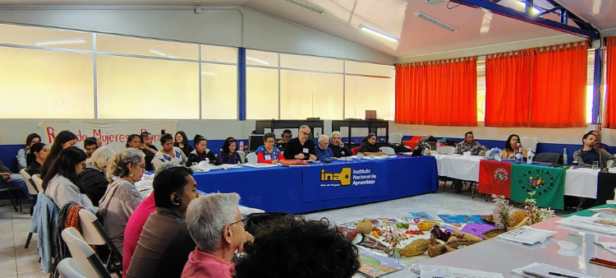
The Permanent People’s Tribunal in Costa Rica, January 2026. Image credit: HyoJin Park/A Growing Culture
The Tribunal heard submissions from a diverse group of farmers’, peasants’ and indigenous organisations, as well as community networks involved in seed defence. People came from across Latin America, and there were online attendees from Asia and Africa—those who could not obtain transit visas to fly via Europe. The Tribunal subsequently made a Declaration in Defence of the Seeds, stating that it had found recognisable, repeated, and therefore structural, mechanisms present in the cases examined.
Since its founding in 1979, the Tribunal has held more than 50 sessions2.These have examined cases where there is impunity and an absence of law, and highlighted gross human rights violations and other crimes. Perpetrators are not limited to states but extend to economic actors—in 2011, for example, the PPT found that six agrochemical companies (including BASF, Bayer and Syngenta) were responsible for “gross, widespread and systematic violations of the right to health and life, economic, social and cultural rights”3.
Between 2011 and 2014, the PPT held sessions in Mexico, and in the process, became known to Ramón Vera Herrera, an editor of the Latin American magazine Biodiversidad, Sustento y Culturas. Ramón is also a member of the Stop UPOV Alliance, which campaigns against repressive seed trade laws, and Alianza Biodiversidad, a collective of 10 Latin American organisations that work in defence of biodiversity, serving as a link among communities, movements, organisations and research groups.
An ancient relationship under attack
It is 8am in Mexico City when we meet4,and Ramón has kindly made time to speak to me before his normal working day starts. In introducing the Alianza, he explains that they work a lot with isolated and detached communities but which are often also at the centre of many attacks and what he describes as a “disabling process”—having their abilities taken away.
Capitalism, says Ramón, “expels you from your land, but it also disregards, erodes, prohibits and criminalises all of your knowledge, strategies and traditions, including your seeds. The idea is to fragment you and make you dependent, so you need to work for another in submission”.
“With the PPT,” he explains, “we arrived at the idea that it’s not only seeds that are attacked, it’s the relationship between people/communities and their crops and seeds. It’s an ancient relationship. It is being violated in a systemic and continuous way.”
According to Ramón, an array of mechanisms attack people’s relationships with their seeds. These include the “disfigurement caused by GMOs”, privatisation, free trade agreements, variety laws, and intellectual property, including the patenting of seeds.
GMOs as an aggression
On GMOs, Ramón explains: “GMOs entail another attack by imposing a foreign gene or an edited arrangement of the genes of a seed. Then you are imposing a configuration. This is an aggression that damages your relationship with your seeds”.
“People of seeds”
For Ramón, the PPT has already reached a hugely significant position: it has recognised, as a category of claimants, “Peoples of Seeds”—pueblos de las semillas—for whom “there are no seeds without people, no people without seeds”.
Ramón recognises that the categorisation is provocative: It’s not ethnographic, or based on race. He says:
When you state that there is a condition of being a People of Seeds, then you are acknowledging a historical fact. These people have been there for so many centuries. So many millennia.
This is not a fixed category or substance, but a complexity based on relations and a history of relations. That history has built life on this planet. It’s crucial that we continue this relationship with crops, with seeds. What we are talking about is a massive attack on life on earth. It’s really very important to confront this”.
It’s not about their trade. It’s not about livelihoods and that’s it. Not only a device or a thing that they use. It’s about a link that bonds you with your seeds. There’s an ontological integrality. A whole condition of living. You are one with the seed since the beginning of time… Being a peasant or farmer, seeds are not only an economic asset, it’s your life, your whole life. You urgently and continually plant again your seed.”
The Great UPOV Scam
Ramón explains that an important mechanism leading to the privatisation of seeds is compliance with UPOV—the International Union for the Protection of New Varieties of Plants. He describes this as “a whole system of restrictions promoted by trade deals that forces countries to pass restrictive seed trade laws that prevent farmers from saving, sharing and selling their seeds, often with extreme punishments such as prison sentences.”
UPOV has been around since 1961 but has hugely increased in reach since then. A September 2026 report by UN experts found that trade agreements are “increasingly” requiring UPOV alignment, and that enforcement has hardened in recent years.
UPOV works on the idea that any manipulation of the seed is an innovation, explains Ramón, and that the one with the most recent manipulation is the owner of that seed.
In fact, he explains: “It has been a collective work, from many centuries back. In the present day you have a momentary appearance of that seed, and then one guy, one corporation, grabs that ‘crystallisation’ of centuries of conversations between people and seeds. They take it, they manipulate it, they say it is theirs because they made it. But any new planting of a seed is changing something—this is the unstoppable transformation of seeds.”
Ramón then quotes Camila Montecinos from La Coordinadora Latinoamericana de Organizaciones del Campo (the Latin American Coordination of Rural Organisations): “That’s like trying to own a house just because you painted it. When the house was built many years back by many persons, and they are still maintaining it in place.”
Ramón says that the terrible thing about UPOV is it’s built on the work that’s been done for centuries: “It’s a huge scam,” he says.
Snapshot of the StopUPOV website
The Permanent Peoples’ Tribunal’s Declaration in Defence of the Seeds
Despite the diversity of communities that presented during the PTT’s sessions in Costa Rica, the resulting Declaration, published on the 21st January 2026, identified a series of universal patterns and structural mechanisms. These include: explicit violence and territorial coercion; lobbying and capture of public decision-making processes; lack of justice; the concentration of profits and the socialisation of risks, and a disproportionate impact on women.
Though it does not say it explicitly, it seems that, as Ramón says, there is a recognition of People of Seeds at the core of the Declaration:
“The organisations that requested the Tribunal represent peoples and populations with an ancestral, daily and intimate connection to the land, its seeds and its agroecological practices. This relationship is not merely productive or based on instrumental knowledge. In their narratives, seeds are a form of cultural continuity and living technology, accumulated over centuries of selection, care, exchange and mutual nurturing as a community practice. The agroecology invoked in these meetings is a way of life and a way of knowing.”
There is continuity between these recent sessions of the PPT looking at seeds, and the 2011 session on agrochemical transnational corporations, which also highlighted the global spread of victims who were “losing their control over their seeds and knowledge”5.
Next steps: the magic
The Tribunal has confirmed that the alleged facts fall fully within its jurisdiction with regard to people’s rights, common goods and structural violence. Evidence will now be gathered, and sessions are planned in seven Latin American countries, as well as in the Asia-Pacific region and possibly Africa.
For Ramón, though, the importance of the Tribunal is not based on a final, non-binding judgement—however groundbreaking that may be—but the way it triggers conversations between people. “It opens spaces—dialogue spaces—everywhere, and starts a systematisation process,” he says. “It enables communities to reflect on the conditions in which they live. The idea of the Tribunal triggers the opening of conversations to understand these conditions. It’s a magic process”.
He explains that, although some of these outcomes are intangible, they cover a lot of the issues that are important for humanity. The acknowledgement of the relation between seeds and humans means people can begin to openly talk about their conditions and their stories and their long journey of having the seeds. In particular, “those seeds that are not disfigured: natural, longstanding and sustainable seeds.”
Stop UPOV week of action
The first week of December is a global week of action against UPOV. On the 2nd December there will be an online rally. To find out more, or to arrange something in your area, contact GM Freeze.
Further reading
-
Alianza Biodiversidad & GRAIN: UPOV: the great seeds robbery, 6 April 2021.
-
Association for Plant Breeding for the Benefit of Society (APBREBES): UPOV’s War against the Rights of Farmers, December 2024.
-
The UN Working Group on the rights of peasants and other people working in rural areas: Penalising peasant seed systems threatens global food supply: UN experts, 16 September 2026.
- Alexander Zaitchik The New Colonialist Food Economy, The Nation, 27 September 2023.
Footnotes
1 Centro Nacional Especializado en Agricultura Orgánica del Instituto Nacional de Aprendizaje (INA)
2 The PPT has examined the cases of Tibet, Western Sahara, Argentina, Eritrea, the Philippines, El Salvador, Afghanistan, East Timor, Zaire, Guatemala, the Armenian Genocide, the intervention of the United States
in Nicaragua, the Brazilian Amazon, Sri Lanka and others.
3 Further, that the three states that the companies were headquartered (USA, Switzerland and Germany) had failed to regulate them adequately.
4 Online interview, 15th September 2026.
5 On the domination and aggression of transnational corporations (TNCs), the 2012 indictment states: “The victims and survivors of TNC aggression are the poor peasants, small-scale farmers, agricultural workers, rural women, children, and indigenous and agricultural communities around the world. They are at the mercy of the expanding power of the agrochemical TNCs and are losing their control over their seeds and knowledge, and suffering debilitating physical and chronic effects due to pesticide poisoning, including coping with the destruction of their children’s health. These small food producers are losing their livelihoods, suffering increased hunger and malnutrition, and having their very means of survival threatened. Even children have been victimized and forced to carry the legacy of pesticide poisoning in their bodies, which is then passed onto their descendants.


