
Legal challenge could put brakes on UK’s GMO deregulation juggernaut
Leonie Nimmo reflects on two days in High Court One
It’s a bright, May afternoon in London, with traffic and people streaming around the Strand. But inside the Royal Courts of Justice, all is hushed and dim, echoes of footsteps lost to vaulted ceilings. I find my way to High Court One, where a Judicial Review is taking place, brought by Beyond GM to challenge the Genetic Technology (Precision Breeding) Regulations (GenTech Regulations).
Passed in March 2025 and coming into force six months later, these create the legal framework for new GMOs to be grown and sold throughout England without the means to identify or detect them, and without meaningful environmental, health or economic risk assessments.
As I enter the court, the prosecution barristers are urging the judge to recognise the rights of two prominent organic farmers—rights which go beyond a set of technical criteria to the core of an individual’s identity and values. These rights could be fatally undermined by the way the government intends for new GMOs (those that it classifies as “precision bred”) to be released. The responsibility for ensuring that they don’t contaminate other crops will rest entirely with GMO-free growers and traders. But they will have no information about what or where new GMOs will be grown, nor any means to detect them.
The case is complex, and the many different issues at play fill boxes of files in front of the legal teams. But the nature of what could be challenged and how is very specific. The case is not about whether the government is right or wrong in how it’s chosen to regulate new GMOs. The case is about whether the process was lawful.
The atmosphere in the room swings from slack boredom to tension stretched to snapping point as the barristers veer between lengthy presentations about seemingly off-topic issues relating to case law, to provocative statements couched in almost-impenetrable legalese.
Risky business
The issue that really sends some static around the room is one that’s not supposed to be discussed at all. Beyond GM’s Pat Thomas explained to me before the case: “We can’t debate or dispute the science in a Judicial Review, only the lawfulness of the government’s actions.”
For this reason, information about the science and the risks of new GMOs doesn’t feature in the evidence prepared by the claimants. But no such restraint is exercised by the legal team working for the Department of Environment and Rural Affairs (Defra).
There is no need for consumer labelling, the Defra barrister says. “The FSA Board concluded there are no safety issues when compared with traditionally bred organisms and that there is no justifiable reason for mandatory labelling on safety grounds.” The government’s position, he says, is that “it is not any more risky, in fact it is slightly less risky, than traditional breeding, because with traditional breeding you might get an unexpected mutation; with precision breeding you are much less likely to get an unexpected mutation”.
At this, there’s an audible gasp and murmurs of dissent from the scientists observing in the public gallery—and I nearly fall off my seat. Not only are these statements fiercely contested, but they are at odds with the regulatory system that’s been developed, which categorises new GMOs according to different levels of risk. The fact that the Defra team sees fit to make such unsubstantiated claims as though they were fact is disturbing and indicative of the kind of behaviour which has led to the legal challenge in the first place.
But the Government barrister presses on, noting that in any case: “Industry have signalled that mandatory food labelling would significantly deter investment in innovation in the UK.”
The challenge
Once the Regulations were signed into law, Beyond GM and its legal team worked against a short deadline to investigate potential permissible grounds to challenge the lawfulness of the GenTech Regulations and gather the necessary evidence. At the end of this, there were four specific grounds on which they sought Judicial Review. In the judge’s ruling three weeks later, the successful challenge was that it was “irrational, including because there was a failure to undertake adequate enquiries”.
When the GenTech Act passed in 2023, much of the detail about how the new system would operate, including whether or not there would be labelling, was yet to be decided. The Regulations that set out these crucial details were drafted by the previous Conservative government but were eventually laid before Parliament and voted through in the early days of a new Labour administration.
Thanks to the tenacity of Beyond GM, we know that the then-Farming Minister Daniel Zeichner was given what was described in the ruling as “erroneous advice” by Defra officials—he did not know (because he was wrongly advised) that he had the power to mandate labelling.
The Defra legal team conceded that Zeichner received two briefings that wrongly stated the law. They claimed this was corrected, but the Court found the Minister’s understanding remained “constrained”.
Zeichner decided to “press on” with the Regulations without making further enquiries about their costs, benefits and how they would operate in practice. According to the ruling:
He prioritised the interests of commercial innovators (and the consequential economic benefits of attracting investment into England) notwithstanding the concerns of, and impact on, the organic sector, consumers, and trade with the European Union and with other parts of the United Kingdom.”
What next?
At the time of writing, the two legal teams are negotiating about how to resolve the problems inherent in the Regulations. Whatever they propose will need to be agreed by the Court at a second hearing in November.
You can support the demand for the government to fix the Regulations by writing to your MP via the Beyond GM website campaign, asking them to stand up for transparency, choice and accountability.
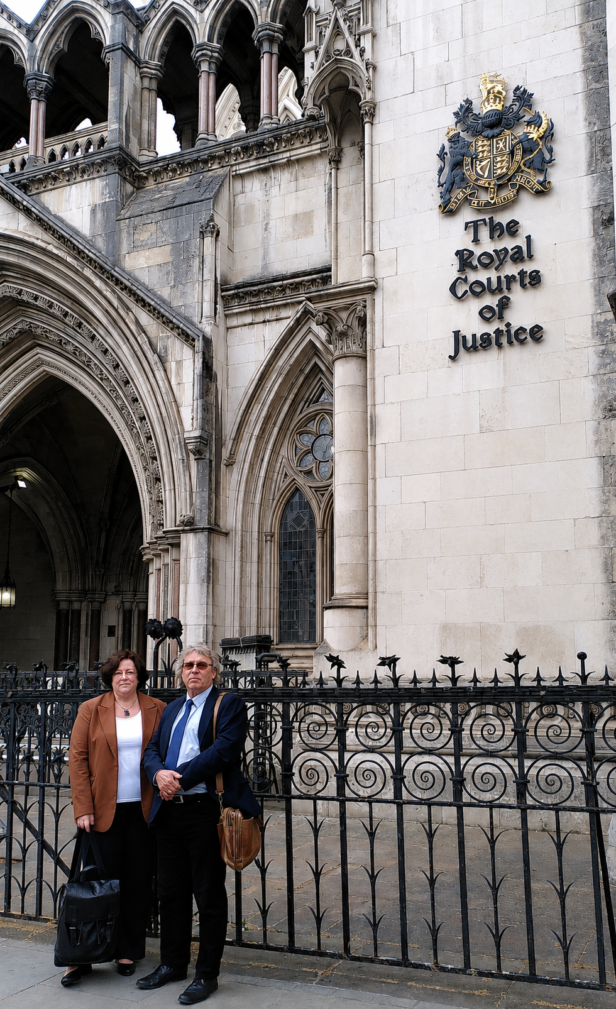
Beyond GM’s Pat Thomas and Lawrence Woodward outside the High Court, 12th May 2026.


